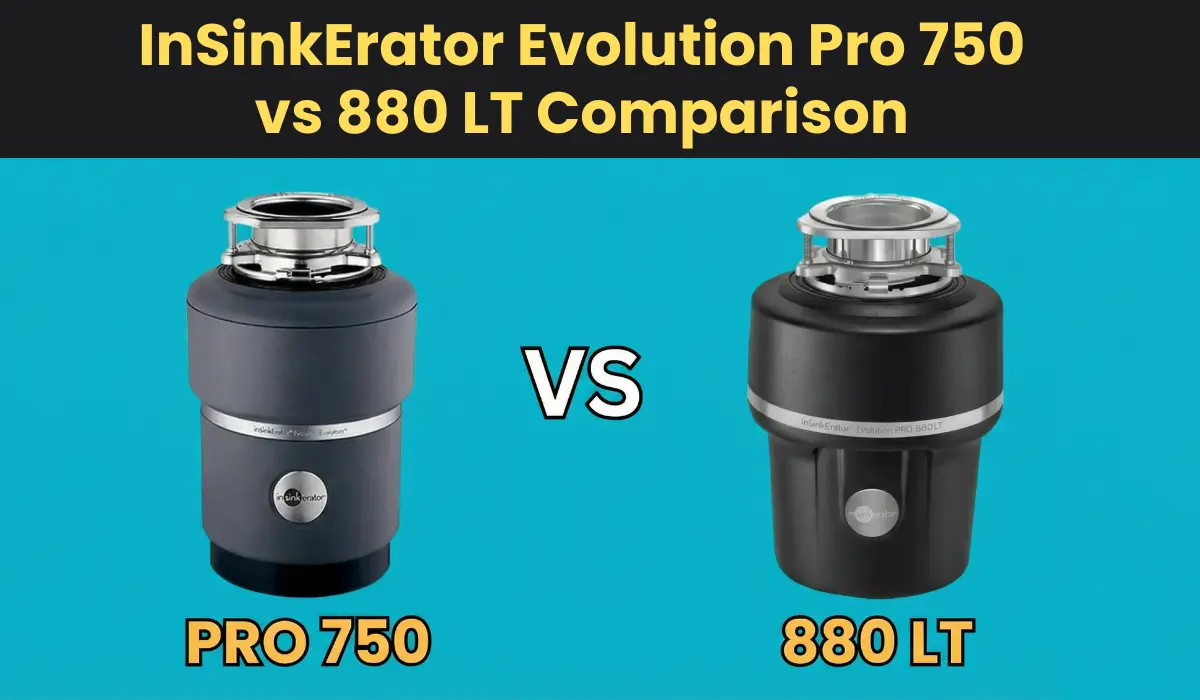
InSinkErator Pro 750 vs 880 LT: Which Pro Series Is Worth Buying?
Two disposals. Same brand. Same motor technology on paper. And a price gap that makes most buyers stop and actually think.
The InSinkErator Pro 750 vs 880 LT question comes up constantly because both units sit in a confusing middle ground above the Badger lineup that plumbers install in new construction, below the full Evolution premium tier, and close enough in specs that picking one feels like a coin flip. It is not a coin flip. The differences between them are specific, and once you understand what they actually mean at the sink, the decision gets cleaner.
One important thing to state upfront: both models are discontinued. InSinkErator no longer produces either unit. Remaining stock moves through Amazon and a handful of plumbing supply retailers, and when that inventory is gone, it is gone. That is not a reason to avoid them, the engineering in both is proven and durable, and the in-home service warranty transfers with the unit. But if you find either at a reasonable price, there is a real clock on that window.
Quick Specs: Pro 750 vs Pro 880 LT
| Feature | InSinkErator Pro 750 | InSinkErator Pro 880 LT |
|---|---|---|
| Motor | 3/4 HP Dura-Drive Induction | 7/8 HP Dura-Drive Induction |
| Motor Speed | 1,725 RPM | 1,725 RPM |
| Grinding System | 2-stage MultiGrind | 2-stage MultiGrind |
| Auto-Reverse | No | Yes |
| Noise System | SoundSeal + Quiet Collar | SoundSeal + Anti-Vibration Mounts |
| Grind Chamber | Stainless steel | Stainless steel, 34.6 oz |
| Power Cord | Included | Included |
| Mount Type | 3-bolt | 3-bolt |
| Warranty | 6-year in-home service | 10-year in-home service |
| Status | Discontinued — limited stock | Discontinued — limited stock |
| Price Range | ~$200 to $280 | ~$270 to $350 |
Motor power
Start with the number that catches everyone’s eye: 3/4 HP versus 7/8 HP. On paper, that 1/8 HP spread looks almost too small to matter. In daily kitchen use, it matters — just not in the way most people assume.
Neither motor will struggle with normal household scraps. Eggshells, soft vegetable trimmings, coffee grounds, cooked pasta — the Pro 750 grinds through all of it without hesitation. The difference shows up when you push both units past the routine. Drop a full batch of vegetable peelings from a serious cooking session into the 750, and the motor slows noticeably before recovering. The 880 LT absorbs the same load without changing pitch.
That reserve capacity is the real story of the horsepower difference. It is not about raw grinding strength. It is about how hard the motor has to work to maintain consistent output under irregular or heavy loads, and how quickly it recovers when you ask too much of it.
Both units run the 2-stage MultiGrind system, which processes food waste through two progressively finer grinding stages before it reaches the drain. That output matters more than motor speed for households with older plumbing or septic systems. The 2-stage system is a meaningful upgrade over the single-stage grinding in the Badger lineup — both units share that advantage equally.
For a two-person household with moderate cooking habits, the Pro 750 is genuinely more than sufficient. For a family that cooks every night and runs the disposal after every meal, the 880 LT’s extra torque removes a source of daily friction.
Noise level
Anyone upgrading from a Badger 5 will immediately notice the difference when the Pro 750 runs. SoundSeal insulation combined with the Quiet Collar baffle at the sink opening brings the noise level down to a low mechanical hum. Normal kitchen conversation while the disposal runs is not an issue.
The Pro 880 LT builds on that foundation with anti-vibration mounting hardware. And that addition does something the foam insulation alone cannot — it breaks the transfer path of mechanical noise through the cabinet structure and into the countertop. The result is a disposal that is not just quieter in the air around it, but quieter in the physical surfaces it is attached to. Run the 880 LT under a granite countertop and the vibration that would normally travel through the mounting into the stone is largely absorbed before it gets there.
Whether that distinction is worth the price difference depends entirely on your kitchen. Open-concept homes where the sink sits in an island or along a wall that opens to a dining or living space — that extra noise suppression pays off every single day. A closed kitchen with its own four walls around it? The Pro 750 is already quiet enough.
Auto-Reverse Feature
The Pro 750 has no auto-reverse. Full stop.
When it jams, it stays jam, because that is what food disposals do. You flip the switch off, get a hex wrench or the InSinkErator jam-buster tool, insert it into the port on the bottom of the unit, manually free the grinding plate, then press the overload reset button on the underside. Two to four minutes. Not technically difficult. But if it happens while you are mid-dinner prep with a hot pan on the stove and dishes stacked in the sink, it is the kind of interruption that genuinely ruins momentum.
The Pro 880 LT reads resistance in the grinding chamber automatically. When it detects what suggests a blockage, the motor reverses direction to clear it. Most jams resolve before you even realize one was developing. The motor pitch changes briefly and then the unit continues normally.
Households that put fibrous scraps through the disposal regularly celery strings, artichoke leaves, corn husks will encounter this situation with the Pro 750 more often than they expect. The 880 LT turns those moments into non-events.
This is the feature that most buyers underweight when comparing the two. The horsepower difference is abstract until you live with it. Auto-reverse is something you notice or appreciate the absence of having to notice within the first week.
Installation: Straightforward on Both Units
The 3-bolt mounting system on both units is well-documented and well-understood. Plumbers and experienced DIYers have been working with it for years across the full InSinkErator lineup. If you are replacing an existing InSinkErator unit that already uses the 3-bolt mount, the hardware stays in place and the swap is purely mechanical.
Both the Pro 750 and Pro 880 LT include a power cord in the box. That is worth noting because several premium InSinkErator units at higher price points the Evolution Excel being the obvious example do not. You plug into a standard outlet. No separate cord purchase, no hardwiring unless you prefer it.
Replacing a non-InSinkErator unit requires swapping the mounting assembly. Add 20 to 30 minutes to your install time for that step, but it is not complicated.
The Pro 880 LT’s compact profile is one of its underappreciated strengths. At roughly the same physical footprint as the Pro 750, it fits in tight under-sink cabinets where larger 1 HP units create clearance problems. Both units are notably more forgiving in cramped installations than the Evolution Excel or Pro 1100XL.
Build Quality
Stainless steel grinding components and a stainless steel grind chamber are standard on both units. This matches the material quality you find in InSinkErator’s premium Evolution tier — not the polymer-chamber construction you see in mid-range or budget units. Stainless holds up under years of exposure to wet food waste and acidic scraps without the corrosion or odor retention that polymer develops over time.
Both units also include a stainless steel sink flange and an anti-microbial splash guard baffle at the opening. The anti-microbial treatment on the baffle is a practical detail that reduces the bacteria buildup and odor accumulation that most people blame on the disposal itself, when the real source is the splash guard surface.
These are not Badger Series units with upgraded branding. The internal construction reflects the Pro designation genuinely.
The Warranty Gap Deserves More Attention Than It Gets
Six years of in-home service on the Pro 750. Ten years on the Pro 880 LT.
Both warranties mean InSinkErator sends a technician to your home when something fails. You do not box the unit, ship it, wait for parts, or reinstall. A service call gets scheduled. That is a genuinely useful warranty, and it is one of the clearest differentiators between InSinkErator’s Pro and Badger lineups at any price point.
Four extra years of that coverage is not a minor footnote. Ten years of in-home service on a kitchen appliance is the kind of protection that outlasts most kitchen renovations. For buyers who want to make one decision and stop thinking about the disposal for a decade, the 880 LT’s warranty is a standalone argument for the price premium.
Who Should Buy Each Unit
The Pro 750 makes sense if your household is two to four people with normal daily cooking. Your kitchen is an enclosed space and disposal noise does not travel into the main living area. You prefer the lower price point and you are comfortable with the occasional manual jam clearing. Pro Series construction and the 6-year warranty still put this unit well above most of what competes at its price.
The Pro 880 LT earns its premium if your household runs the disposal hard after multiple daily meals, your kitchen opens into a living or dining space, and the idea of fishing a hex wrench under the sink mid-dinner prep is something you would rather never do. The 10-year warranty and auto-reverse combination turns this into a genuinely set-it-and-forget-it purchase for most households.
If either unit is out of stock or priced unusually high, the current active replacements worth considering are the Evolution Compact 3/4 HP for households that would have chosen the Pro 750, and the Evolution 1 HP or Pro 1100XL for households leaning toward the Pro 880 LT. Our full garbage disposals guide covers the complete current lineup side by side.
The Bottom Line
These two units are close enough in construction that buyers sometimes spend more time comparing them than the decision actually warrants. The Pro 750 is a solid Pro Series disposal at a fair price. The Pro 880 LT is a better disposal — quieter, self-clearing, and backed by a warranty that is genuinely exceptional in this category.
If the 880 LT is available within a reasonable price range, it is the stronger long-term purchase. The auto-reverse alone removes a recurring irritation from daily kitchen life that you will not fully appreciate until you have lived without it for a while. The four extra warranty years are a bonus on top of that.
Buy the Pro 750 when budget is the primary constraint and the performance gap is genuinely acceptable for your household. Buy the Pro 880 LT when you want to make the purchase once and not think about it again.
FAQ’s
The Author

Muhammad Nabeel Dar is the founder of GarbageWasteDisposal.com, where he researches and evaluates garbage disposals, kitchen sinks, dishwashers, and kitchen drain systems to help homeowners make confident buying decisions.
After analyzing 30+ garbage disposal models, multiple sink configurations, and a wide range of drain system components across brands like InSinkErator, Waste King, Moen, GE, Frigidaire, and KRAUS, he focuses on what actually matters: real-world performance, build quality, noise levels, installation ease, durability, and overall value.