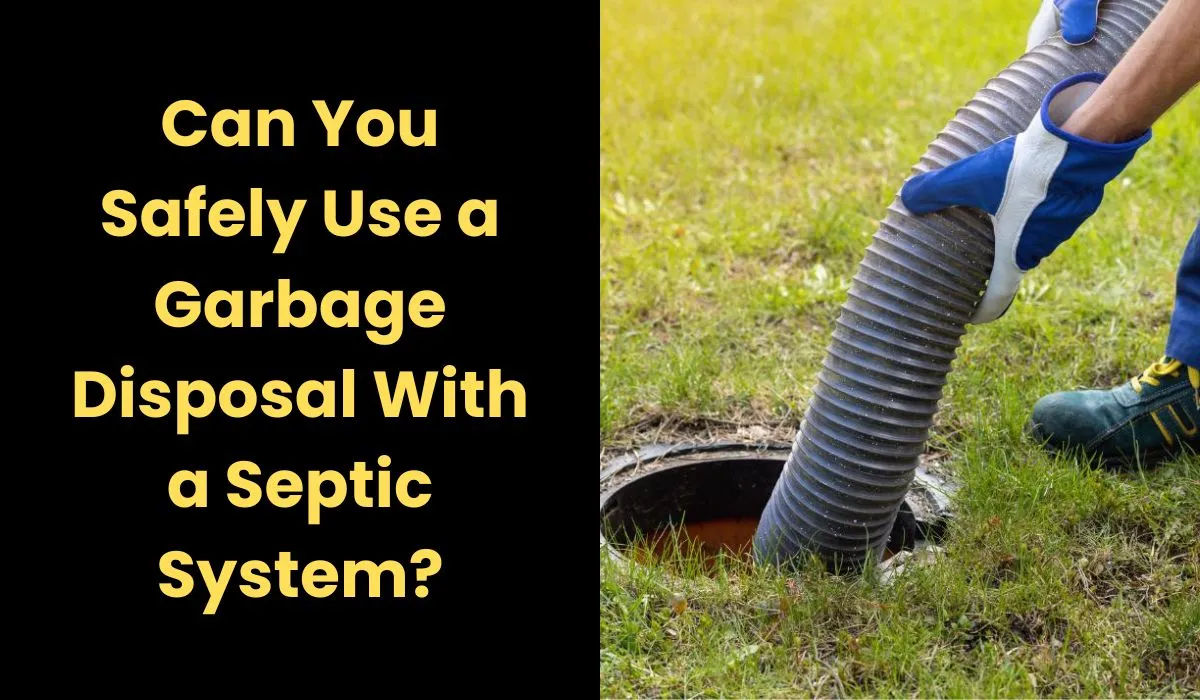
Can You Safely Use a Garbage Disposal With a Septic System?
Search for “garbage disposal septic safe” and you will find yourself in the middle of an argument. One camp swears that any disposal will wreck a septic tank within a year. The other, often selling a product, suggests that a bottle of enzymes can solve the problem. Neither side tells the whole story.
Quick answer: A garbage disposal can be safe to use with a septic system, but only if the tank is properly sized for the additional solids and you treat the disposal as a convenience, not a trash compactor. Septic-specific models with enzyme cartridges are not a requirement. Research from septic researchers suggests that a healthy, properly maintained system rarely needs them. They are a convenience that some households may choose to pay for, not a solution for an undersized or poorly managed tank.
Here is what actually determines whether your septic system can handle a garbage disposal, and what matters far less than the marketing suggests.
How garbage disposal Works with a septic tank
A garbage disposal grinds food waste into fine particles that flow with water into your septic tank. Inside the tank, bacteria break down organic matter as part of the normal treatment process. Finely ground food particles decompose relatively quickly, especially compared to large solids.
The concern is volume. A disposal adds solid material to your tank faster than a household without one. If the tank is too small or isn’t maintained, the added load can cause problems — sludge buildup, more frequent pumping, or drain field issues.
What Makes a Garbage Disposal Septic-Safe in the First Place?
There is no government certification for a septic-safe garbage disposal. No agency stamps a unit and clears it for tank use. What manufacturers call septic-safe is really a bundle, a standard grinding motor paired with an enzyme or bacteria cartridge, sold at a premium over an otherwise identical model.
Look at the specs and the mechanical side barely changes. Septic-branded disposals run the same horsepower tiers and the same grinding stages as the standard models sitting next to them in a brand’s own lineup. What actually changes is the extras bundled on top, an enzyme or bacteria cartridge dispenser, sometimes added sound insulation, and often a longer in-home service warranty.
Expect to pay for the difference. Septic-branded models typically run $250 to $350, against $75 to $250 for a comparable standard unit. That gap buys convenience and a cartridge subscription, not a fundamentally different disposal. Further down, we compare one real septic-branded pick against one real standard pick so you can see exactly where that money goes.
Do Septic-Safe Additives and Enzyme Boosters Actually Work?
Manufacturers make bold claims here. InSinkErator markets its Septic Guard Refill as scientifically proven to break down food waste and safe for plumbing and septic fields. That is a real, tested product. It is also not the whole picture.
The University of Minnesota’s Onsite Sewage Treatment Program, one of the more cited academic voices on residential septic systems, takes a cooler view. Its research and most septic professionals describe bacterial and enzyme additives as largely unnecessary in a tank that is already healthy, since a functioning septic system generates its own bacteria without help. Some go further and warn that certain additives can disturb the natural balance more than they improve it.
So which is right? Both, in a narrow sense. An enzyme cartridge will not hurt a properly sized system, and it is not going to rescue an undersized one either. If your tank is already struggling, the fix is tank capacity and usage habits, not a $15 bottle every few months.
The Usage Rules That Actually Protect Your Septic Tank
Forget the additives for a moment. The habits below do more for your septic system than any cartridge on the market.
Run cold water for 15 to 30 seconds before, during, and after every grind. Cold water keeps fats solid enough to grind cleanly instead of coating your pipes. Grind small batches rather than dumping a full plate at once, and never treat the disposal as your primary trash method, plate scrapings only.
Keep these items away from the drain entirely: grease and cooking oil, fibrous vegetables like celery, bones, shells, coffee grounds, and eggshells. None of them break down the way soft food scraps do, and grease in particular hardens inside the line long after it leaves the disposal.
Skip bleach, lye, and phosphate-based cleaners too. Lye is corrosive enough to damage pipes over time. Bleach and phosphates both kill the bacteria your tank depends on to break solids down. Small amounts in everyday dish soap will not hurt anything, dumping either one down the drain in bulk will.
Does a Garbage Disposal Really Mean More Septic Pumping?
Yes, somewhat, though the exact number depends on who you ask and how big your tank is. A standard septic system typically needs pumping every 3 to 5 years. Add a garbage disposal in regular use, and most guidance shifts that window to roughly every 2 to 3 years, sometimes closer to 1 to 2 years in households that lean on the disposal heavily.
The reason comes down to solids, not myths about clogging. The University of Minnesota’s onsite sewage research and the National Environmental Services Center both point to disposals increasing suspended solids entering the tank by around 30 percent, with biological oxygen demand climbing by as much as 50 percent in some measurements. More solids settling at the bottom means more sludge, and more sludge means an earlier pumping visit.
Budget for it. Extra pumping typically adds $75 to $150 a year, which works out to $750 to $1,500 over a decade. That is a real cost, but it is nowhere near the $5,000 to $15,000 a failed drain field can run if solids are allowed to escape a tank that was never sized for the load in the first place.
Is Your Septic Tank Even Big Enough for a Disposal?
This is the question that actually matters, more than any additive or model choice. There is no separate sizing formula for households with a disposal. A correctly sized septic tank for your bedroom count should already absorb the extra load without issue.
Tank size scales with bedrooms, not disposal use specifically, since bedroom count is the standard proxy for daily water use.
Standard Septic Tank Sizes (US)
| Bedrooms | Minimum Tank Size |
|---|---|
| 2 | 750 gallons |
| 3 | 1,000 gallons |
| 4 | 1,250 gallons |
| 5 | 1,500 gallons |
If your current tank falls short, you have two honest options. Add an auxiliary chamber, which typically runs $4,000 to $5,000, or skip the disposal and compost food scraps instead. For the mechanics of how a tank processes waste in the first place, our full septic tank guide walks through the primary and secondary chambers in more depth.
Best Garbage Disposals for Septic Systems
Once your tank is sized correctly, almost any disposal will work. These two cover the two real paths worth considering.
InSinkErator’s Evolution Septic Assist is the dedicated septic pick, 3/4 HP, two-stage grinding, SoundSeal noise insulation, and a Bio-Charge cartridge bundled in, backed by an 8-year in-home service warranty. It is the safer choice for anyone who wants the enzyme boost without researching additives separately, even if the research above suggests the boost matters less than the marketing implies.
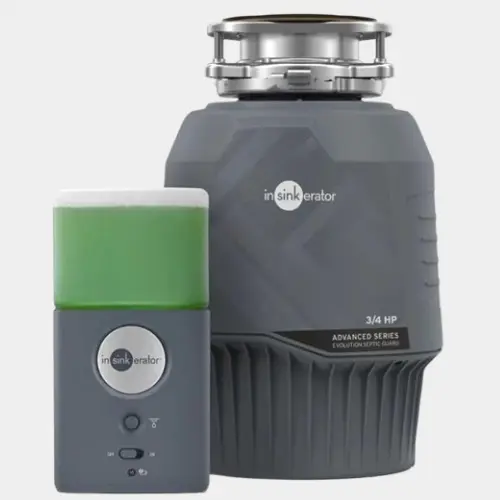
Key features:
- Stainless steel grind components
- 3/4 HP motor
- Built-in Bio Charge enzyme dispenser
- SoundSeal technology for quiet operation
Budget-conscious and confident your tank is properly sized? The Waste King L-3200 grinds at the same 3/4 HP tier for a fraction of the price, with a stainless steel swiveling impeller that handles bones and fruit pits without complaint. Skip the cartridge, follow the usage rules above, and it performs just as reliably on a septic system as the pricier option.

Key features:
- Stainless steel grind components
- 3/4 HP motor
- Pre Installed Power cord
- Compact and Lightweight Design
Conclusion
A garbage disposal and a septic tank can coexist without drama. The tank size does the real work here, not the enzyme cartridge on the shelf at the hardware store. Get that right, follow basic usage habits, and budget for pumping a year or two earlier than you would otherwise. Everything else, including which specific model you buy, is a much smaller decision than the marketing around septic-safe disposals wants you to believe.
FAQ’s
The Author

Muhammad Nabeel Dar is the founder of GarbageWasteDisposal.com, where he researches and evaluates garbage disposals, kitchen sinks, dishwashers, and kitchen drain systems to help homeowners make confident buying decisions.
After analyzing 30+ garbage disposal models, multiple sink configurations, and a wide range of drain system components across brands like InSinkErator, Waste King, Moen, GE, Frigidaire, and KRAUS, he focuses on what actually matters: real-world performance, build quality, noise levels, installation ease, durability, and overall value.