Do Garbage Disposals Need GFCI?
Short answer: yes, your garbage disposal outlet needs GFCI protection. Whether that is actually required by code in your jurisdiction depends on which NEC edition your local authority has adopted, but the safety case exists regardless of what the code says where you live.
Garbage disposals sit in wet environments, run near water, and stay plugged in continuously under a cabinet most homeowners never inspect. That combination is precisely the scenario GFCI protection was designed for. If you want a deeper explanation of how GFCI devices detect faults and cut power, that is covered in our general GFCI guide. What this article covers is the disposal-specific requirement, how it changed across NEC editions, what differs between plug-in and hardwired installations, and what causes a disposal to keep tripping a GFCI outlet.
What the NEC Actually Requires Across Different Editions
This matters because most US jurisdictions adopt the NEC on a delay. Your local code might be the 2017, 2020, or 2023 edition depending on where you live, and the answer to “is GFCI required” is slightly different in each.
NEC 2017 was the edition that settled the plug-in disposal question definitively. Any receptacle within 6 feet of a kitchen sink required GFCI protection under that edition, and the outlet supplying a disposal sits maybe 8 inches from the drain. No credible argument places it outside that zone. Hardwired disposals connected directly to a junction box had no receptacle to protect, so the 6-foot rule left them in a technical gray area that many inspectors filled with a common-sense recommendation to use a GFCI breaker anyway.
NEC 2020 kept the same 6-foot rule and added specificity around dishwashers and under-sink appliances, but did not fundamentally change the disposal outlet requirement.
NEC 2023 closed the gray areas that earlier editions left open. The 2023 edition requires GFCI protection on every 125-volt to 250-volt receptacle in a kitchen, not just those within 6 feet of a sink. Position no longer matters. If it is a kitchen receptacle, it needs GFCI protection. Hardwired disposals still fall outside the receptacle language technically, but the 2023 edition’s broader kitchen circuit requirements and the now-standard practice of installing dual-function GFCI/AFCI breakers in new construction effectively bring hardwired units under the protection umbrella.
If your jurisdiction is still on NEC 2017 or earlier, the plug-in disposal outlet has been GFCI-required since that edition. If you are in a 2023-adopted jurisdiction, every kitchen receptacle carries the same requirement.
Plug-In Disposals vs. Hardwired Disposals
| Connection Type | GFCI Required by Code | Recommended |
|---|---|---|
| Plug-in disposal, receptacle under sink | Yes, NEC 2017 and all later editions | Yes |
| Hardwired disposal, direct junction box | Not explicitly under receptacle rules | Yes, GFCI breaker at panel |
Most residential disposals plug into a standard outlet under the sink. That outlet is in a kitchen. Under every currently adopted NEC edition in the US, it requires GFCI protection. A standard outlet at that location without a GFCI device fails inspection in virtually any jurisdiction.
Hardwired units are a different conversation. The NEC’s receptacle-specific language cannot technically reach a connection with no receptacle. This creates genuine debate among electricians, and the DIY forums are full of arguments about it. The practical answer most working electricians give is simple: install a GFCI breaker at the panel for a hardwired disposal. The code debate becomes irrelevant, the protection is real, and no inspector will flag it.
Three Ways to Provide GFCI Protection for a Disposal
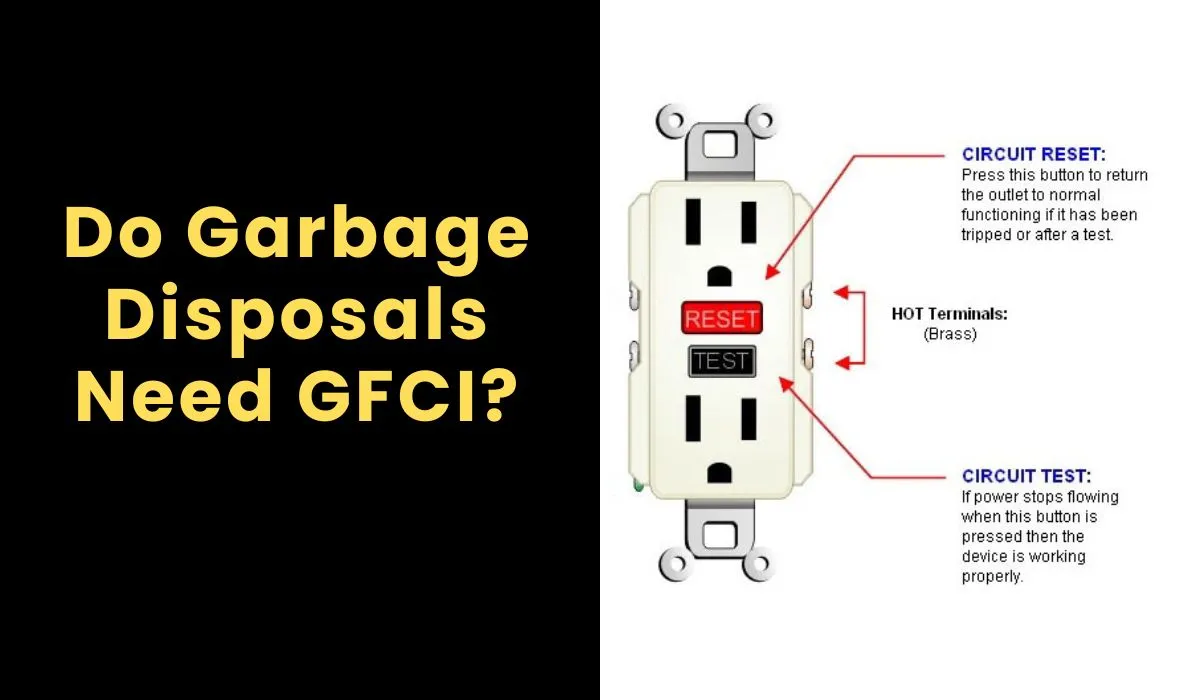
- Replacing the outlet under the sink is what most homeowners do for plug-in disposals. Swap the standard receptacle for a GFCI outlet, connect the disposal to the LINE side, and the job is done. If a dishwasher outlet is also under that sink, wire it to the LOAD terminals of the GFCI outlet. That extends protection to the dishwasher through the same device. One GFCI outlet, two protected appliances.
- A GFCI circuit breaker at the panel covers the entire disposal circuit from a single point. This is the right solution for hardwired disposals and the cleaner solution for any kitchen electrical update, since it protects everything on that circuit regardless of how the disposal connects. Standard GFCI breakers run $30 to $60. Dual-function GFCI/AFCI breakers, now standard in many jurisdictions for new kitchen circuits, run $40 to $80 and add arc fault protection on top of ground fault protection.
- An upstream GFCI outlet on the same circuit sometimes already covers the under-sink outlet through its LOAD terminals. Before installing anything new, test the under-sink outlet with a plug-in GFCI tester to confirm whether it is already protected downstream from a countertop GFCI outlet. If it is, label it “GFCI Protected” per NEC requirements and you are done.
Why Disposals Specifically Need This Protection
A kitchen with no water near the outlets is a reasonable place to debate how much GFCI protection is actually necessary. Under a sink is not that place.
Disposal motors run in continuous moisture. The seal between the grinding chamber and the motor housing is the only barrier between water and wiring. When that seal degrades after years of use, water does not make a dramatic entrance. It seeps. Slowly. The early stages produce no grinding noise change, no obvious symptom. The wiring gets wet, a fault current develops, and if there is no GFCI device on that circuit, a standard 15 or 20-amp breaker will not trip. The fault current is far too low. The GFCI trips at 4 to 6 milliamperes. The circuit breaker does not trip until 15,000 milliamperes. That gap is the entire reason the two devices exist separately.
Drain leaks add the other dimension. Water pooling under the sink reaches the outlet or power cord eventually. Any homeowner who has opened a cabinet to find standing water under the disposal knows how quickly things get wet down there. GFCI protection is not an abundance of caution in that environment. It is basic electrical safety.
Why Your Garbage Disposal Keeps Tripping the GFCI
A disposal that trips a GFCI outlet is not automatically a sign of a failing disposal. The GFCI is doing its job: detecting fault current and cutting power. The question is what is generating the fault.
| Cause | Pattern | Fix |
|---|---|---|
| Moisture in the outlet or cabinet | Trips after rain, pipe sweating, or recent leak | Dry the area, find the moisture source, inspect outlet for water damage |
| Worn motor seal | Trips after a few seconds of running, worsens over time | Motor seal failure is not repairable, replace the disposal |
| Damaged power cord | Trips immediately or intermittently | Inspect the cord for cracks or abrasion against cabinet edges, replace if damaged |
| Reversed LINE and LOAD terminals | Trips immediately on first use after GFCI installation | Rewire correctly, incoming power to LINE, downstream devices to LOAD |
| Shared circuit overload | Trips only when dishwasher or other appliance runs simultaneously | Separate the circuit or upgrade to a 20-amp dedicated line |
| Aging GFCI outlet | False trips with no identifiable fault, unit is over 10 to 15 years old | Test with the TEST button, replace the GFCI outlet if it does not trip on command |
A disposal that trips the GFCI the moment you flip the switch points to a wiring error or direct moisture in the motor. One that runs for a few seconds before tripping usually means the motor is generating heat that accelerates a fault in degraded wiring or a failing seal. One that only trips when something else on the circuit runs simultaneously is a capacity problem, not a disposal problem.
FAQ’s
The Author

Muhammad Nabeel Dar is the founder of GarbageWasteDisposal.com, where he researches and evaluates garbage disposals, kitchen sinks, dishwashers, and kitchen drain systems to help homeowners make confident buying decisions.
After analyzing 30+ garbage disposal models, multiple sink configurations, and a wide range of drain system components across brands like InSinkErator, Waste King, Moen, GE, Frigidaire, and KRAUS, he focuses on what actually matters: real-world performance, build quality, noise levels, installation ease, durability, and overall value.