How to Recycle a Garbage Disposal: Where to Take It
So you pulled the old disposal off the sink and now it is sitting on the kitchen floor. Do not bag it up with the regular trash. There is actual money inside that thing.
Garbage disposals are built from steel, aluminum, and copper. The copper alone, wound inside the motor, is valuable enough that most scrap yards will take the unit without charging you. Some will hand you a few dollars for it. Either way, garbage disposal recycle is a 20-minute errand that keeps recoverable metal out of a landfill, and it costs you nothing.
What Makes a Garbage Disposal Recyclable
Steel and aluminum make up the grinding chamber, housing, and mounting hardware. The motor inside contains copper windings, which is the highest-value material in any small appliance motor by weight. Stainless steel grinding components are standard across InSinkErator’s Evolution and Pro Series lineup. The splash guard and rubber gasket material typically gets separated at the facility rather than processed with the metal.
Scrap yards classify a disposal as mixed metal or light iron. Weight determines the payout, and copper content in the motor is what drives whatever value exists. On a standard 10 to 15 pound residential unit, the return is small, somewhere between a dollar and five dollars depending on current scrap prices in your area. Nobody gets rich recycling a disposal, but the metal is genuinely recoverable and keeping it out of a landfill costs you nothing extra once you have decided to take it somewhere.
Removing the Unit Before You Take It In
Work through this in sequence. Skipping the electrical step first creates a real hazard. You’ll need a screwdriver, a bucket, and a non-contact voltage tester if your unit is hardwired.
Step 1: Cut the Power
Power off before touching anything. Flip the circuit breaker feeding the disposal, or unplug it from the outlet under the sink if it is a plug-in unit. If the disposal is hardwired rather than plug-in, use a non-contact voltage tester to confirm the circuit is dead before opening any wiring connections.
Step 2: Disconnect the Drain Trap
Once power is confirmed off, loosen the slip-joint nut where the discharge tube meets the P-trap. Pull the tube free and keep a bucket underneath since water sitting in the trap will spill. If a dishwasher drains through the disposal, the hose clamp on the dishwasher inlet needs loosening and the hose pulled free before the unit can drop.
Step 3: Disconnect the Wiring
Hardwired units have a small cover plate on the bottom of the disposal body. Remove it, unscrew the wire nuts joining the disposal wires to the house supply wires, and pull the ground wire off the green screw. Plug-in units are already free electrically once unplugged.
Step 4: Release the Mounting Ring
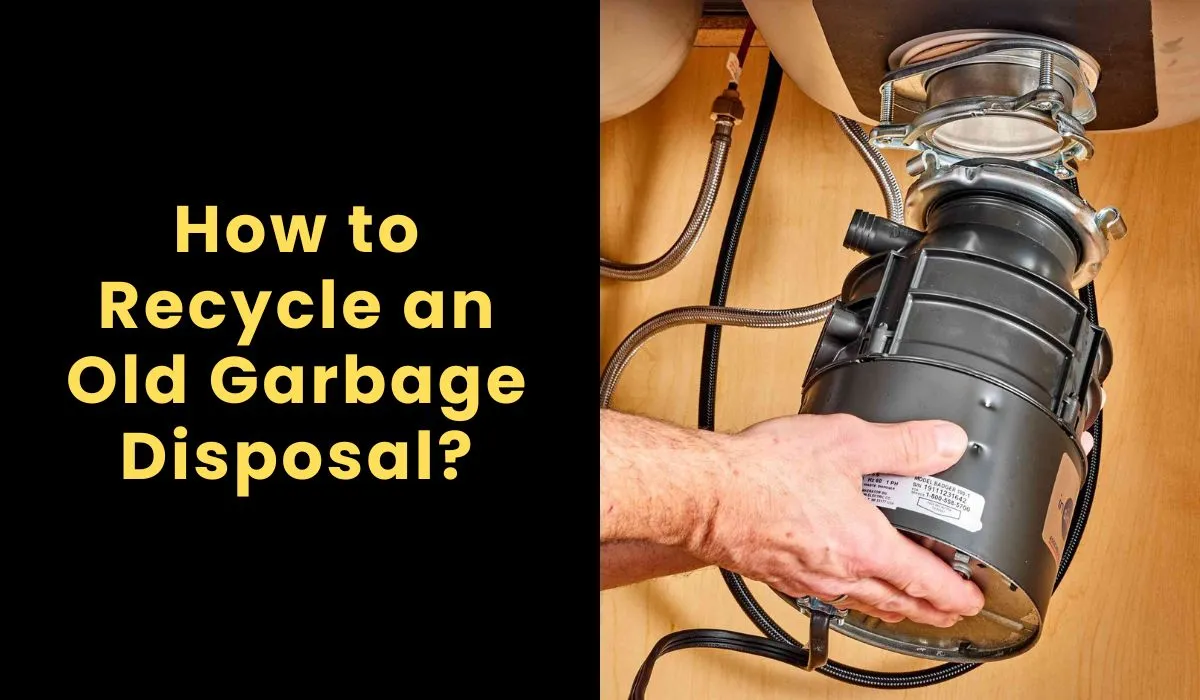
Support the disposal from underneath with both hands, rotate the lower mounting ring counterclockwise, and the unit releases from the mounting assembly. They are heavier than they look. A 1 HP unit weighs close to 20 pounds.
Where to Recycle a Garbage Disposal Near You
Scrap metal yards are the most reliable option in any US city or suburb. Search “scrap metal yard near me” or “salvage yard near me” and call ahead before loading up the car. Two questions worth asking: do they accept small appliances, and do they require the power cord to be detached before drop-off. Some facilities process cords separately as e-waste and want them removed beforehand. Detaching the cord takes about two minutes with a screwdriver at the cover plate on the bottom of the unit.
For a broader search, Earth911.com is the most comprehensive recycling facility database in the US. Enter “small appliances” as the material type along with your zip code and it returns nearby facilities with addresses, accepted materials, and hours. This works better than calling scrap yards one by one when you are not sure what is available in your area.
Municipal options vary more by location but are worth checking. Most cities and counties run transfer stations or recycling drop-off centers that accept small appliances. Many also schedule periodic bulk appliance collection events at no charge. Searching your city or county name alongside “appliance recycling drop-off” usually surfaces the local program page with dates and accepted items.
Retailer haul-away is worth asking about if you are already buying a replacement. Some big-box retailers and independent plumbing supply stores will remove the old unit when they deliver and install the new one. It is not universal, but asking at checkout costs nothing.
Curbside bulk pickup is the lowest-effort route where it exists. Many municipal waste programs include scheduled bulk item collection days for items too large for standard bins. Check your local public works website for the pickup schedule and any requirements around how to tag or place the item at the curb.
Throwing It Away vs. Recycling It
Putting a garbage disposal in the regular trash is legal in most US jurisdictions. It does not carry the hazardous waste restrictions that apply to batteries, paint cans, or fluorescent bulbs.
Whether it is the sensible choice is a different question. Steel, aluminum, and copper all have active secondary markets. Scrap yards take the unit for free even when they do not pay for it. A 20-minute trip to drop it off recovers materials that would otherwise sit compressed in a landfill. For most homeowners, that trade is straightforward.
Conclusion
Recycling an old garbage disposal isn’t a chore, it’s a 20-minute errand that puts real material back into circulation instead of a landfill. Steel, aluminum, and copper all have someone willing to take them, a scrap yard, a municipal drop-off, or the retailer delivering your next unit. Do the removal in the right order, power off first, drain trap disconnected, wiring confirmed dead, and the whole job costs you nothing but a little time.
FAQ’s
The Author

Muhammad Nabeel Dar is the founder of GarbageWasteDisposal.com, where he researches and evaluates garbage disposals, kitchen sinks, dishwashers, and kitchen drain systems to help homeowners make confident buying decisions.
After analyzing 30+ garbage disposal models, multiple sink configurations, and a wide range of drain system components across brands like InSinkErator, Waste King, Moen, GE, Frigidaire, and KRAUS, he focuses on what actually matters: real-world performance, build quality, noise levels, installation ease, durability, and overall value.