
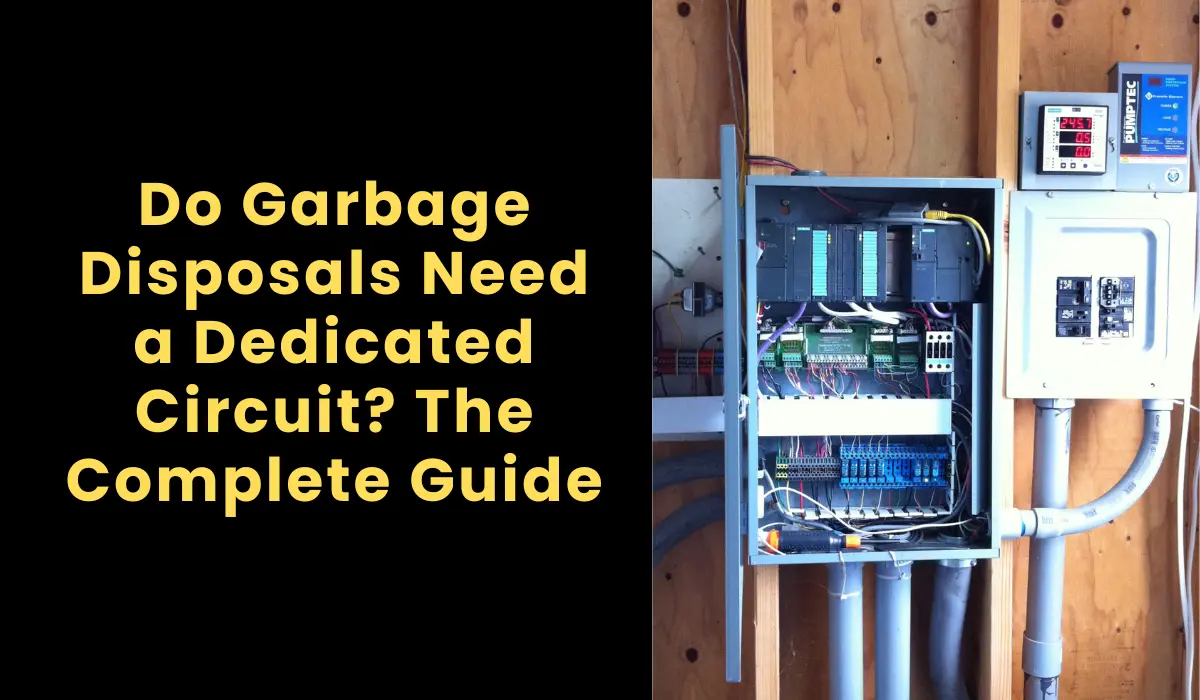
Do Garbage Disposals Need a Dedicated Circuit? The Complete Guide
Most homeowners ask this after their breaker trips mid-cycle and someone tells them the circuit is shared. Others hit it during a new installation when the electrician asks whether there is a dedicated line. Either way, the answer is the same.
Yes. A dedicated circuit is the correct and recommended electrical setup for any garbage disposal. What that means in practice, why shared circuits cause specific damage to disposal motors, and how to check what you currently have is what this guide covers.
What is a Dedicated Circuit?
A dedicated circuit serves one appliance and nothing else. It has its own breaker in the electrical panel and its own wire running to that single outlet or connection point. Nothing else on the property shares that line.
This matters for garbage disposals because motors do not draw steady current. A disposal does not pull the same amperage the whole time it runs. At the moment the motor starts, it draws a burst of current three to six times higher than its normal running amperage before settling once it reaches operating speed. That startup surge is called inrush current.
A 1 HP disposal with a normal running draw of around 10 amps may pull 25 to 35 amps for a fraction of a second at startup. On a dedicated circuit with no other load, the breaker holds because it is sized for that possibility. On a shared circuit already carrying load from a microwave or countertop outlet, that same startup spike pushes total draw past the breaker threshold. The breaker trips, the disposal stops, and the homeowner assumes the unit is faulty when the actual problem is circuit capacity.
This is one of the most common disposal complaints that has nothing to do with the disposal itself.
What the NEC Actually Requires
The National Electrical Code does not contain a single article that reads “garbage disposals must have a dedicated circuit” in every case. What it does contain pushes most installations there in practice.
NEC Article 210 prohibits fixed appliances from sharing small appliance branch circuits that serve countertop receptacles. A garbage disposal is a fixed appliance. Connecting it to a countertop circuit violates this provision.
NEC Article 422 requires that motor-driven appliances drawing more than half the branch circuit rating have their own branch circuit or share only with compatible appliances. A 3/4 HP disposal drawing 8 amps on a 15-amp circuit is consuming over 53% of that circuit’s capacity at running load. That calculation, before inrush is even considered, lands it in dedicated territory under NEC 422.
Most local jurisdictions go further and explicitly require dedicated disposal circuits in their local amendments. Any licensed electrician doing a new kitchen installation treats a dedicated disposal circuit as standard practice regardless of whether the specific local code mandates it.
Circuit and Wire Sizing by Disposal Motor
| Disposal Motor | Typical Running Amps | Inrush (Approx.) | Minimum Circuit | Wire Gauge |
|---|---|---|---|---|
| 1/3 HP | 3 to 5 amps | 10 to 15 amps | 15 amp | 14 AWG |
| 1/2 HP | 4 to 7 amps | 12 to 20 amps | 15 amp | 14 AWG |
| 3/4 HP | 7 to 9 amps | 18 to 25 amps | 15 or 20 amp | 12 AWG recommended |
| 7/8 HP | 8 to 10 amps | 20 to 28 amps | 20 amp | 12 AWG |
| 1 HP | 9 to 12 amps | 25 to 35 amps | 20 amp | 12 AWG |
Wire gauge matters as much as breaker size. Running 14 AWG wire on a 20-amp circuit is a code violation under NEC regardless of the actual load carried. A 20-amp breaker requires 12 AWG wire. If your disposal is on a 20-amp circuit, confirm the wire gauge before assuming the setup is correct. Most homes wired with 14 AWG throughout have 15-amp circuits only, and a 1 HP disposal on a 15-amp circuit is undersized.
For current draw figures on specific models across popular brands, the amp usage data by model breaks down the numbers in detail.
What a Shared Circuit Does to the Motor Over Time
Tripped breakers are the obvious symptom. The slower damage is less visible.
When a disposal starts on a circuit already carrying partial load, the voltage at the motor sags at the moment of startup. Instead of a clean 120 volts, the motor may see 105 to 110 volts because the circuit cannot sustain full voltage under combined inrush demand. The motor compensates by drawing more current to produce the same starting torque, which increases heat in the motor windings.
Repeated over months and years, that thermal stress accelerates insulation wear inside the motor. The unit keeps running, but its service life shortens in a way that is not visible until the motor fails. InSinkErator’s own installation documentation calls for dedicated circuits partly because of this. It is not a catastrophic single event. It is slow degradation that shortens what should be a 10-year disposal into a 6-year one.
The Dishwasher Exception
The one widely accepted exception is sharing a 20-amp circuit with a dishwasher. Electricians and inspectors across the US routinely accept this because a dishwasher and a disposal almost never run simultaneously in normal kitchen use. A dishwasher runs long cycles of 45 to 90 minutes. A disposal runs 20 to 45 seconds. The overlap probability is low enough that a shared 20-amp circuit typically holds.
The conditions matter. The circuit must be 20 amps with 12 AWG wiring. A 15-amp shared circuit between these two appliances is not acceptable. And in households where someone runs the disposal during active dishwasher operation, even a 20-amp shared circuit can trip. If that happens regularly, a dedicated disposal circuit solves it.
Sharing with countertop receptacles, microwaves, refrigerators, or any other fixed appliance violates NEC Article 210.
How to Check Whether You Have a Dedicated Circuit
You do not need to open the panel to do this.
Find the breaker labeled “Disposal” or “Kitchen Disposal.” Turn it off. The outlet under the sink should lose power. Nothing else in the kitchen should lose power. No countertop outlets should go dead.
If other things lose power when you switch that breaker, the circuit is shared. Note what goes off so you can describe the configuration to an electrician.
If no breaker is labeled for the disposal, find which breaker controls the under-sink outlet by switching them until power at that outlet drops. Then run the same check.
The whole process takes under five minutes.
FAQ’s
The Author

Muhammad Nabeel Dar is the founder of GarbageWasteDisposal.com, where he researches and evaluates garbage disposals, kitchen sinks, dishwashers, and kitchen drain systems to help homeowners make confident buying decisions.
After analyzing 30+ garbage disposal models, multiple sink configurations, and a wide range of drain system components across brands like InSinkErator, Waste King, Moen, GE, Frigidaire, and KRAUS, he focuses on what actually matters: real-world performance, build quality, noise levels, installation ease, durability, and overall value.



One Comment
Comments are closed.