InSinkErator Septic Guard Refill: How Often to Replace It
The InSinkErator Septic Guard Refill runs out quietly. No warning light, no smell change you’d notice right away, just a slow drift back to whatever your septic system was doing before you installed it. Most owners replace it later than they should, mainly because nothing forces the issue.
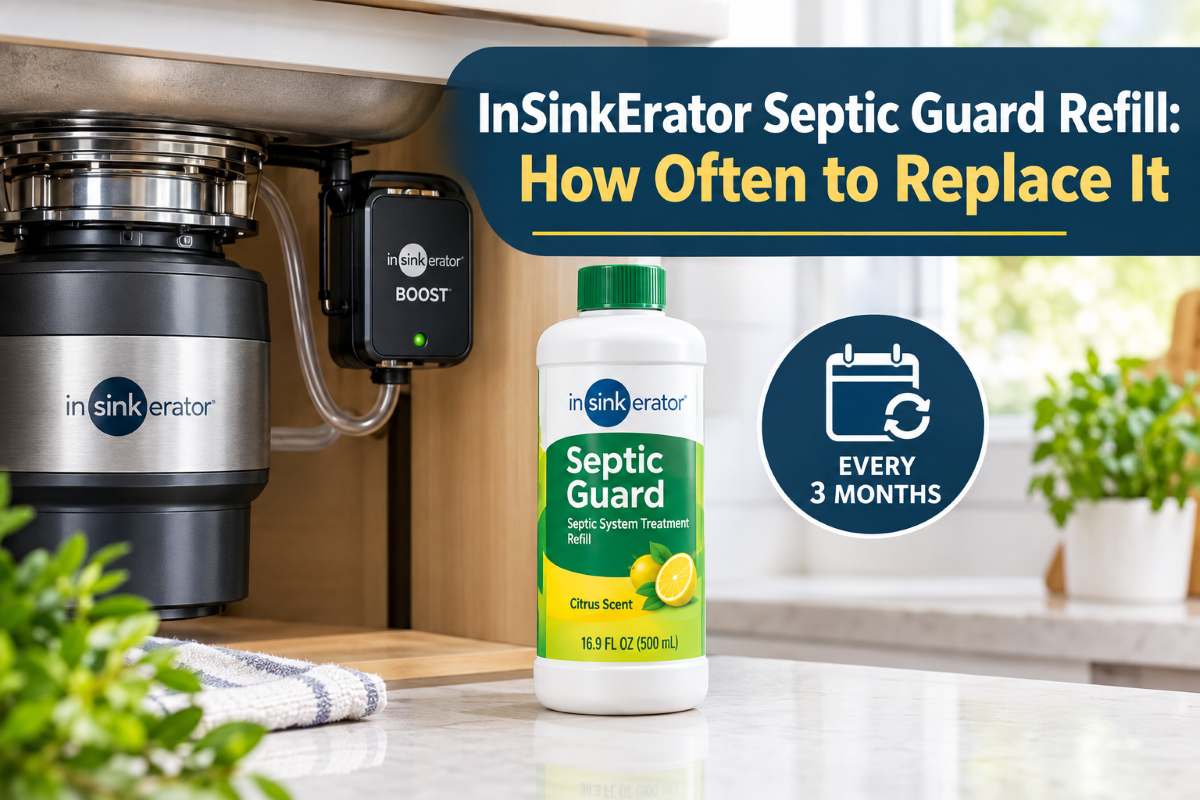
Here’s the number that actually matters: about three months. The BOOST system doses Septic Guard solution twice a day, every 12 hours, and a 16.9 fl oz bottle is built to last roughly that stretch at that rate. A big household running the disposal daily will burn through one faster.
What the InSinkErator Septic Guard Refill Actually Does
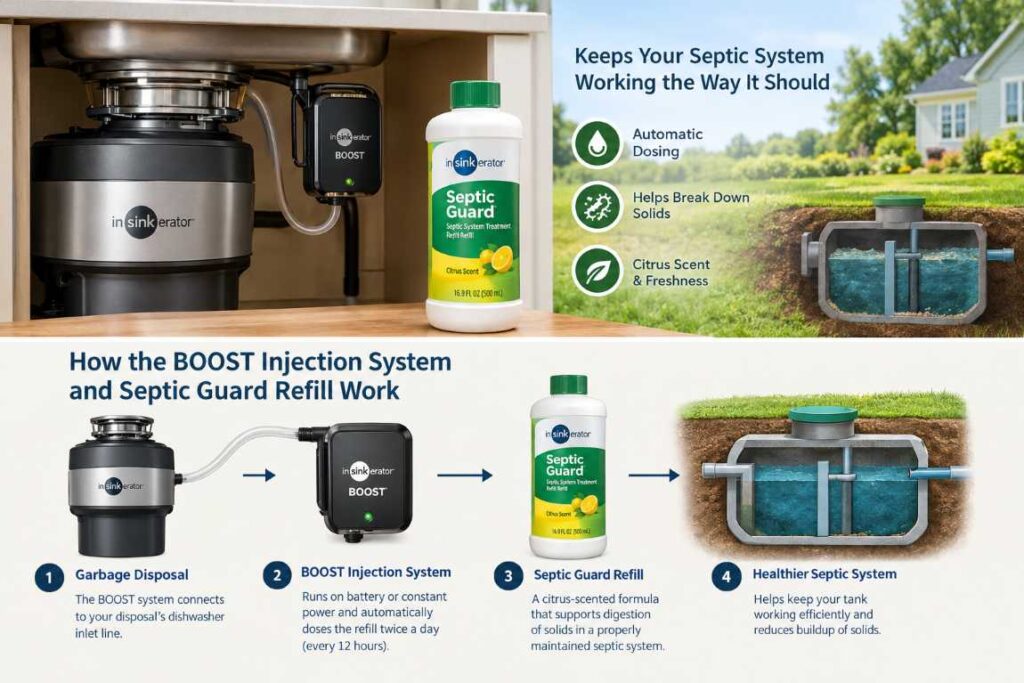
The BOOST Injection System is the hardware, a small accessory that connects to your disposal’s dishwasher inlet and runs on battery power or a constant wall outlet. The Septic Guard Refill is the consumable it dispenses, a citrus-scented liquid formula InSinkErator describes as scientifically formulated to support digestion of solids in a properly maintained septic system.
Twice a day, on a 12-hour cycle, the unit injects a small dose automatically. No manual pouring, no remembering to add anything to the drain yourself. That automation is the whole pitch. Septic maintenance happens whether you think about it or not, right up until the bottle runs dry.
Every claim InSinkErator publishes about the formula carries the same line attached: “for a properly maintained septic system.” The product supports a tank that’s already sized and cared for correctly. It doesn’t fix one that isn’t.
How Often You Actually Need to Replace It
Three months is the number to plan around, and it comes from the math, not a marketing guess. Two injections a day, every day, for roughly 90 days works out to close to 180 doses per 16.9 fl oz bottle. A Home Depot reviewer said they were still on their first cartridge after a few weeks of regular use, which tracks with a three-month bottle rather than something shorter.
Your actual mileage depends on two things. A larger household running the disposal daily will drain a cartridge faster than a couple using it a few times a week. And if the injection system loses power, batteries die, or the unit gets unplugged, it simply stops dosing rather than doubling up later, so a dead battery is worth checking before you assume the cartridge itself is empty.
Set a reminder for the 90-day mark rather than waiting for a visible sign. There is no low-fluid indicator on the unit itself.
Which Disposals It Works With
Here is the part most buyers get wrong: the BOOST Injection System and its Septic Guard Refill are not locked to one disposal model. InSinkErator states the system is compatible with all InSinkErator garbage disposals, not just the Evolution Septic Guard it ships bundled with out of the box.
If you already own a different InSinkErator disposal, continuous feed or batch feed, you can add the BOOST accessory separately (InSinkErator lists it under SKU 80051-ISE) and start using the same Septic Guard Refill cartridges from there. You are not required to replace an existing disposal just to get septic support.
One thing to keep straight: this is a different system from InSinkErator’s older Bio-Charge cartridge, built into the Evolution Septic Assist line. The two aren’t interchangeable. A Bio-Charge cartridge won’t fit a BOOST unit, and vice versa. Not sure which one you have? Check whether the accessory sits externally on the dishwasher inlet line (that’s BOOST) or is built into the disposal body itself (that’s Bio-Charge).
How to Replace the InSinkErator Septic Guard Refill Cartridge
InSinkErator designed the swap to be a DIY job, and it is a short one.
Step 1: Confirm the BOOST unit is powered, either on battery or connected to a constant wall outlet. It cannot dose anything, old cartridge or new, without power.
Step 2: Release the spent cartridge. The refill uses a click-into-place design, so the empty bottle unclips from the injection housing without tools.
Step 3: Click the new Septic Guard Refill bottle into the same housing until it seats and locks.
Step 4: Check that the unit resumes its twice-daily cycle. Then note the install date somewhere visible, a phone reminder or a sticker on the cabinet under the sink, since the system gives no low-fluid warning on its own.
That’s the entire process. No plumbing tools, no service call.
Is It Worth the Cost?
A 2-pack of Septic Guard Refill runs about $49.98 at Home Depot, roughly $25 per bottle. At one bottle every three months, that works out to close to $8.33 a month, or about $100 a year, to keep the system running continuously.
Compare that to manual septic-safe disposal cleaners you pour in yourself on a monthly schedule, which typically run $10 to $15 a month depending on the brand. The BOOST refill lands in a similar cost bracket. You’re paying for the convenience, not a lower price.
Whether it’s worth buying in the first place is a separate question from how often to replace it. Septic researchers are split on whether these additives are even necessary for a tank that’s already properly sized. If you already own the BOOST system, replacing the cartridge on schedule is the cheap, low-effort choice. If you’re deciding whether to buy one at all, a correctly sized septic tank matters more than any additive on the market.
Conclusion
The InSinkErator Septic Guard Refill asks very little of you. Replace it every three months, on a schedule rather than a hunch, and it keeps dosing without you thinking about it in between. The bigger question, whether an enzyme additive does meaningful work for your specific tank, matters more than which refill brand you buy. That one comes down to tank size, not anything in a bottle.
FAQ’s
The Author

Muhammad Nabeel Dar is the founder of GarbageWasteDisposal.com, where he researches and evaluates garbage disposals, kitchen sinks, dishwashers, and kitchen drain systems to help homeowners make confident buying decisions.
After analyzing 30+ garbage disposal models, multiple sink configurations, and a wide range of drain system components across brands like InSinkErator, Waste King, Moen, GE, Frigidaire, and KRAUS, he focuses on what actually matters: real-world performance, build quality, noise levels, installation ease, durability, and overall value.