Garbage Disposal Allen Wrench: How to Unjam Your Disposal Step by Step
The garbage disposal hums, nothing spins, and now you are on the floor under the sink with an Allen wrench trying to figure out what to do with it. Most homeowners reach this point knowing they are supposed to stick the wrench into something on the bottom of the disposal but not much beyond that.
Here is what is happening: the grinding plate inside the disposal is locked. Something got wedged between the impellers and the grind ring, and the motor cannot push past it. The Allen wrench socket on the bottom of the disposal connects directly to the motor shaft. Turning the wrench manually rotates the grinding plate past whatever is jamming it.
If the garbage disposal Allen wrench won’t turn, the jam is tight. That does not mean the disposal is broken. It means you need to work the wrench differently.
What Size Allen Wrench Fits a Garbage Disposal
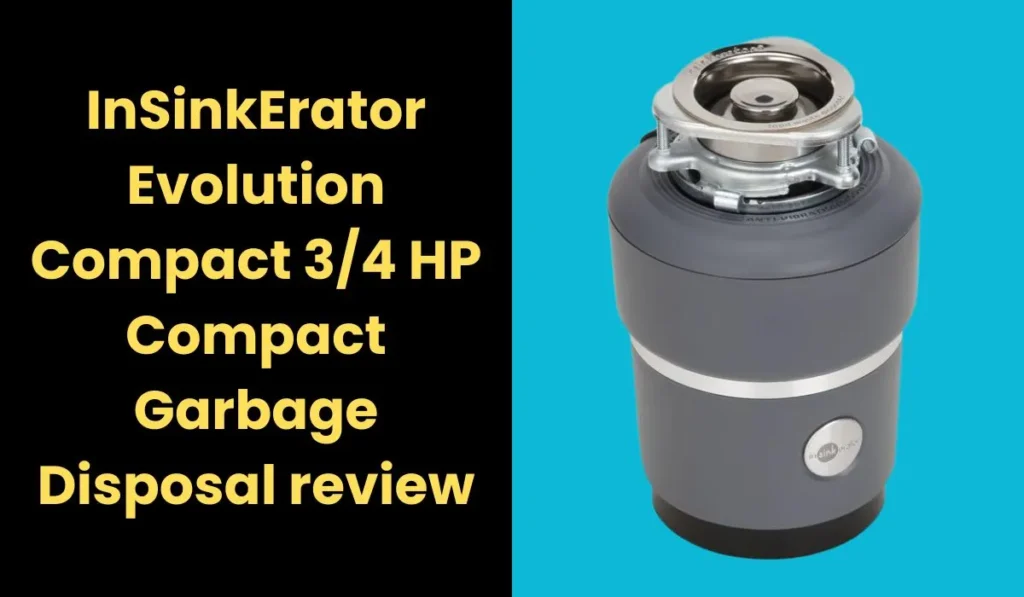
1/4 inch is the standard size for every InSinkErator disposal sold in the US. InSinkErator includes a 1/4 inch hex wrench (they call it a Jam-Buster or self-service wrench) in the box with every unit. If you lost it, any standard 1/4 inch Allen wrench from a hardware store or a hex key set works identically.
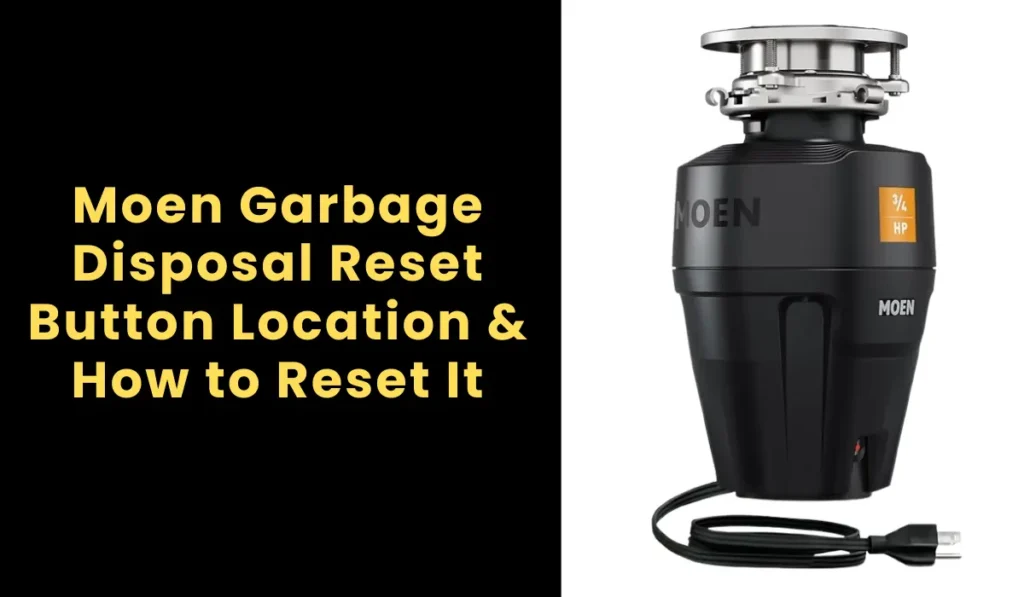
Moen disposals with a bottom hex socket (EX75C, GXS75C, GX50C) also use a 1/4 inch wrench. Some Moen Prep Series models (GXP50C, GXP33C) do not have a bottom hex socket at all and require a different unjamming method.
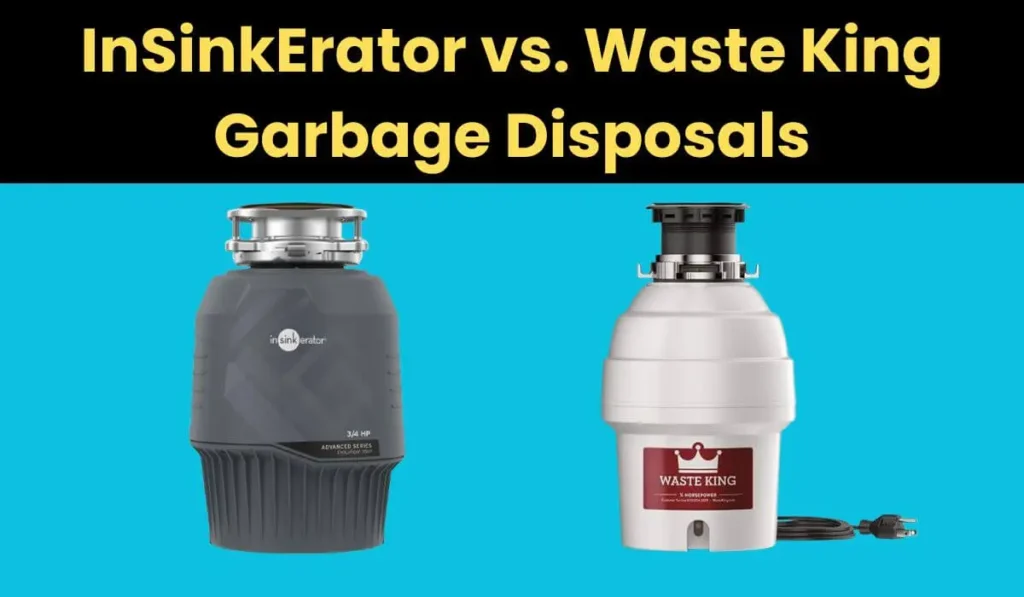
Most Waste King models do not have a bottom hex socket. Waste King disposals are unjammed from above using a wooden broom handle pressed against the impeller through the drain opening.
If you are under the sink looking at the bottom of your disposal and there is no hex-shaped hole, your model does not use the Allen wrench method. Check the brand and model number stamped on the unit.
Where Is the Allen Wrench Hole on a Garbage Disposal
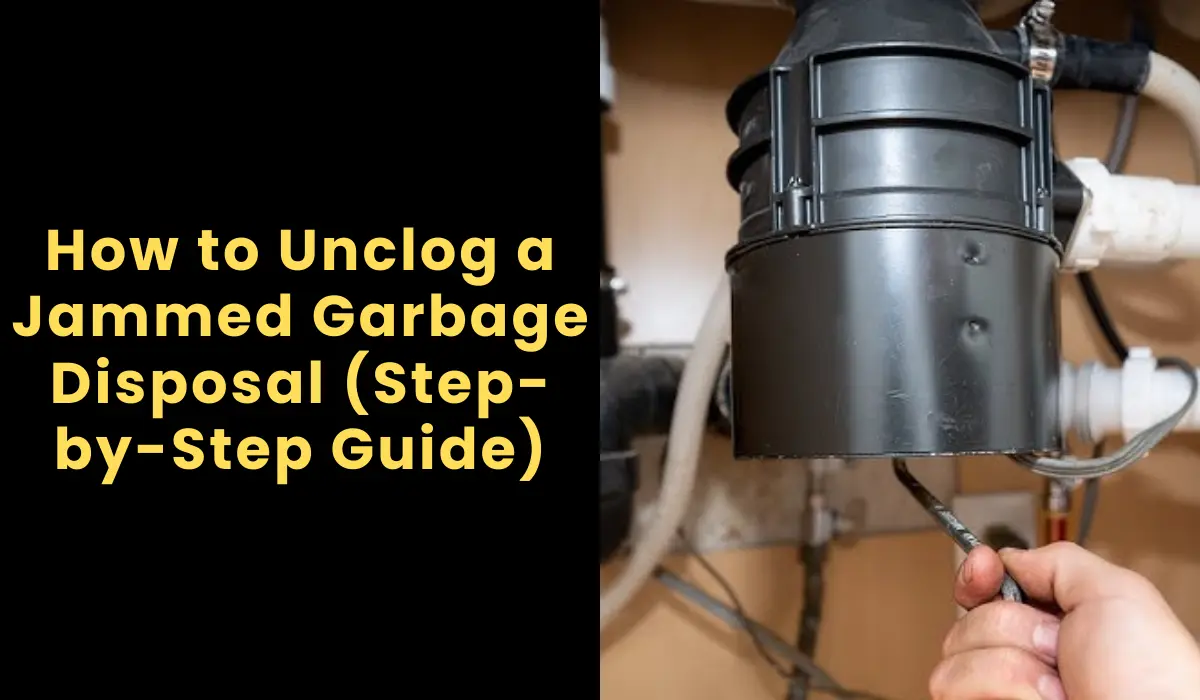
Bottom of the unit. Dead center. Look for a small hex-shaped hole, usually about the diameter of a pencil. On InSinkErator models it is always centered on the very bottom of the disposal body.
On some models the hole is slightly recessed and hard to spot in the dark space under a sink cabinet. Use a flashlight. Feel around the center of the bottom surface with your finger. The socket is there on any InSinkErator or Moen model that supports the wrench method.
How to Fix a Jammed Garbage Disposal with an Allen Wrench
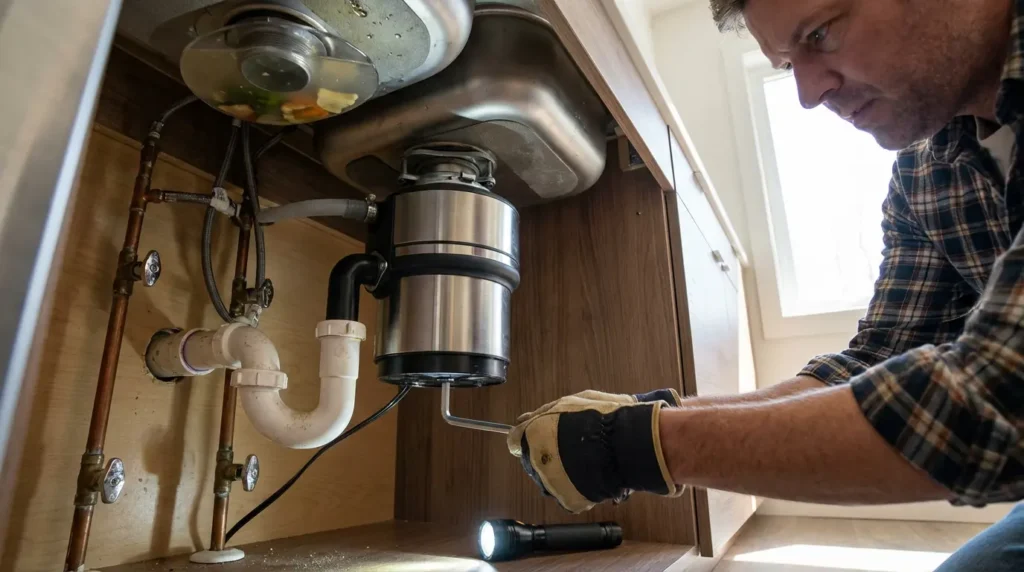
Turn off the disposal at the wall switch. Then unplug it from the outlet under the sink or flip the breaker if it is hardwired. Do not work on a disposal that could accidentally turn on. This is not optional.
Before reaching for the wrench, look inside the chamber with a flashlight. Sometimes the jam is something visible that you can pull out with tongs or needle-nose pliers. A bottle cap, a piece of glass, a chicken bone wedged between the impellers. Removing the object directly saves you the wrench step entirely.
If nothing visible is causing the jam, get under the sink with the 1/4 inch Allen wrench. Insert it into the hex socket at the bottom center of the disposal.
Which Way to Turn the Allen Wrench on a Garbage Disposal
Back and forth. Not just one direction.
Push the wrench clockwise a short distance, then counterclockwise. Rock it back and forth repeatedly. You are working the grinding plate past the obstruction from both sides. Trying to force a full rotation in one direction when the jam is tight risks bending the wrench or stripping the hex socket.
You will feel resistance at first. That is the impellers pushing against whatever is stuck. Keep rocking the wrench with steady pressure. As the obstruction loosens, the range of motion increases. Once the wrench rotates a full 360 degrees without catching, the jam is cleared.
What to Do When the Garbage Disposal Allen Wrench Won’t Turn
The wrench is in the socket and it will not move in either direction. This means the jam is tight. Do not grab pliers and try to force it. A bent wrench or a stripped socket makes the problem worse.
Try this instead. Apply a few drops of penetrating oil (WD-40, PB Blaster, or similar) down the drain opening and let it sit for 10 to 15 minutes. The oil works into the gap between the jammed object and the grinding surfaces and reduces friction. After waiting, try rocking the wrench again with steady pressure. Most tight jams release after the oil has time to work.
If the wrench still will not budge after the oil treatment, work from above. Put a thick wooden broom handle or wooden dowel into the disposal through the drain opening. Press the end against one of the impeller paddles and push firmly to try rotating the plate. The leverage from above combined with the wrench from below sometimes breaks a jam that neither method alone can handle.
If neither direction yields any movement from above or below after multiple attempts, something is seriously wedged or the motor shaft has seized. At that point, stop. Continuing to force it risks cracking the grind ring or damaging the motor. This is where a professional evaluation or replacement becomes the practical answer.
The Allen Wrench Is Stuck in the Garbage Disposal
This is different from the disposal being jammed. The wrench went in, you turned it, and now the wrench itself will not come back out.
Usually the wrench is caught on a lip or edge inside the hex socket. Pull straight down while wiggling the wrench gently. Do not pull at an angle because that wedges it tighter. If it genuinely will not release with a straight downward pull, try rotating it 1/8 of a turn and pulling again. The hex faces have six positions and one of them typically releases cleaner than the others.
If the wrench is truly stuck and nothing frees it, the hex socket may be damaged (rounded or deformed from previous forced turns). In that situation, use locking pliers (Vise-Grips) on the exposed portion of the wrench and pull firmly straight down while rotating slightly. That usually extracts it.
After Clearing the Jam
Once the wrench turns freely through a full rotation, remove it. Look inside the disposal with a flashlight and pull out any loose debris with tongs. Whatever jammed the disposal is now free inside the chamber and needs to come out before you run the motor again.
Find the red reset button on the bottom of the disposal. If it popped out during the jam, press it firmly until it clicks. That resets the thermal overload protector.
Restore power. Run cold water. Turn the disposal on. It should spin immediately without humming or hesitation. Let it run for 20 to 30 seconds to flush any remaining debris. Listen for normal operation sounds. If it hums again, the jam was not fully cleared and you need to repeat the process.
When the Wrench Turns Freely but the Disposal Still Does Not Work
This tells you the jam is cleared but something else is wrong.
If the wrench turns freely and the disposal hums when powered on, the motor is trying but the impellers are not engaging. That usually means internal mechanical failure rather than an obstruction.
If the wrench turns freely and the disposal makes no sound at all, the problem is electrical. Check the reset button, the GFCI outlet, and the circuit breaker in that order.
If the wrench turns freely and the disposal runs but drains slowly, the clog is in the pipe past the disposal, not in the chamber.
How To Prevent Disposal Future Jams
Run cold water for 15 to 20 seconds after every use. Feed food in gradually, not all at once. Avoid hard objects like bones thicker than a chicken wing, fruit pits, and shellfish shells. Keep fibrous foods like celery, corn husks, and tough leafy greens out of the disposal entirely.
Keep the Allen wrench in the cabinet under the sink. When the next jam happens, and it will eventually, having the wrench within arm’s reach turns a potential 15-minute search-and-fix into a 30-second job.
FAQ’s
The Author

Muhammad Nabeel Dar is the founder of GarbageWasteDisposal.com, where he researches and evaluates garbage disposals, kitchen sinks, dishwashers, and kitchen drain systems to help homeowners make confident buying decisions.
After analyzing 30+ garbage disposal models, multiple sink configurations, and a wide range of drain system components across brands like InSinkErator, Waste King, Moen, GE, Frigidaire, and KRAUS, he focuses on what actually matters: real-world performance, build quality, noise levels, installation ease, durability, and overall value.