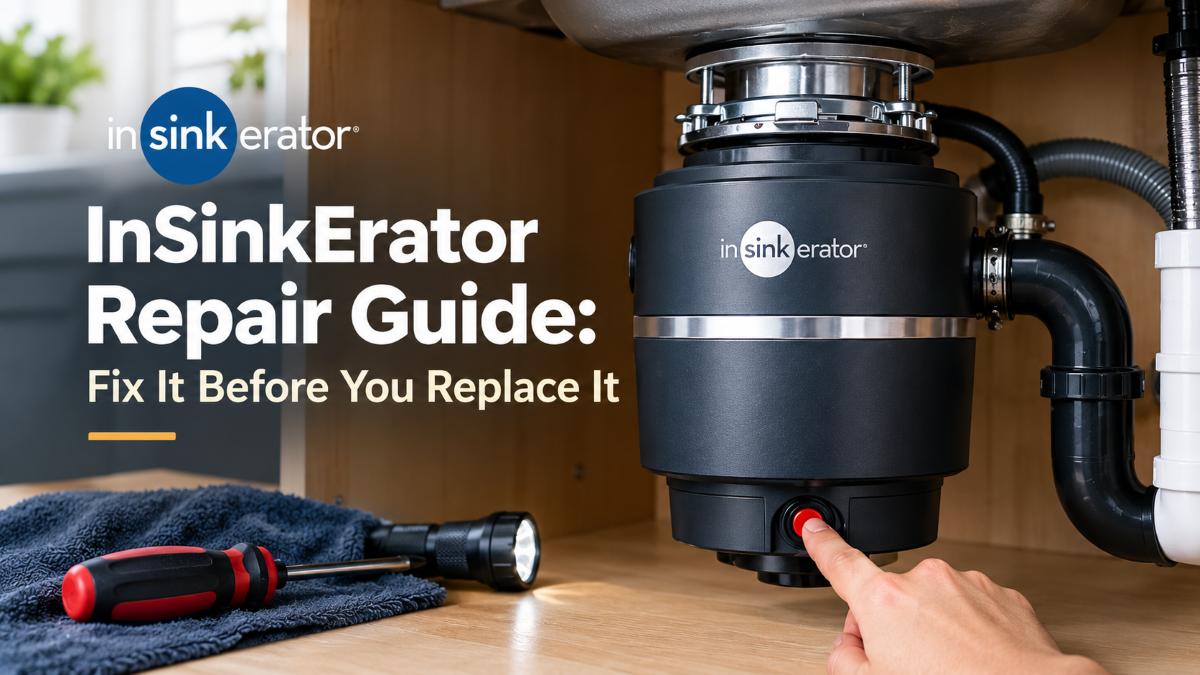
InSinkErator Repair Guide: Fix It Before You Replace It
Most InSinkErator garbage disposal repair calls end the same way, somebody presses a red button and the disposal works again. That covers a surprising share of “broken” disposals. The harder question, and the one most guides skip, is knowing when pressing that button stops being the right move and buying a new one starts making more sense, especially since that answer changes a lot depending on which InSinkErator you actually own.
The Reset Button: Your First Move
Before anything else, flip off the power, wait a few minutes for the motor to cool, clear any visible jam with a flashlight and tongs, then press the small red button on the bottom of the unit until it clicks. Restore power and test with cold water running.
That covers the basics, but InSinkErator’s reset mechanism has a few model-specific quirks worth knowing before you call it broken, what to do if the button won’t stay in, how to tell a motor-hot trip from a genuine jam, and when a tripping GFCI is the actual culprit instead of the disposal itself. Our full InSinkErator reset walkthrough covers every one of those cases in detail.
Common InSinkErator Failure Points
Across the InSinkErator lineup, the same handful of problems show up again and again: the unit hums but won’t spin (a jammed grind plate, fixable with a 1/4 inch Allen wrench through the bottom hex socket), it won’t turn on at all (usually electrical, check the reset button, the GFCI, then the breaker in that order), it leaks (location tells you the cause, sink flange means the putty seal failed, the bottom means the internal motor seal did), or it smells (food buildup in the splash guard and grind ring, not a motor problem).
The budget Badger line runs galvanized steel components that wear faster than the stainless steel in InSinkErator’s Evolution and Pro tiers, so grinding performance drops off sooner on those models specifically. Our Badger line troubleshooting guide walks through all seven of these problems with the exact fix for each, worth a look if a Badger is what you own.
When Repair Stops Making Financial Sense
Here’s the part that actually differs by which InSinkErator you have, and it’s the piece most repair guides get wrong by treating every disposal the same. A common rule of thumb says replace once a repair bill passes roughly half the cost of a new unit. That threshold means something completely different depending on your model.
A Badger 5 replaces for around $80 to $110. A $100 repair bill on that unit isn’t a close call, it’s already over the replacement price. An Evolution Excel or a Pro series unit runs $300 or more to replace, so that same $100 repair is an easy yes. The disposal’s price tier, not just the symptom, decides the math.
General repair costs run $75 to $150 for a jam or reset issue, $100 to $250 for electrical or switch problems, and $200 to $350 for actual motor repair, based on current market rates. Once you’re quoting motor repair on a Badger-tier unit, you’ve already crossed into replacement territory. On a higher-tier InSinkErator, the same repair often still makes sense. Our full replacement cost breakdown covers the buying side of that decision in more depth.
Warranty by Line: What’s Actually Covered
InSinkErator’s warranty length tracks its price tiers closely, and knowing where your model sits changes whether a repair call should even cost you anything.
| Product Line | Typical Warranty |
|---|---|
| Badger 1 | 1 year |
| Badger 5 | 2 years |
| Badger 5XP | 3 years |
| Evolution Essential | 4 years |
| Evolution Select | 6 years |
| Evolution Select Plus | 7 years |
| Evolution Compact | 8 years |
| Evolution Essential XTR | 9 years |
| Evolution Excel | 10 years |
A Badger 5 past its 2-year warranty window is paying out of pocket for any repair. An Evolution Excel at year 6 is still fully covered under its 10-year in-home service warranty, meaning a motor failure that would sink a Badger owner’s decision costs an Excel owner nothing but a phone call. Check your specific model’s documentation, InSinkErator has adjusted terms across generations, but the tier pattern holds.
DIY Repair vs Calling a Pro
Jam clearing, reset troubleshooting, and cleaning are all reasonable DIY jobs, most take under 15 minutes with basic tools. Anything involving the internal motor seal, replacing wiring, or a leak from the motor housing itself is not user-serviceable on most InSinkErator models and needs a professional or a warranty claim.
Plumbers typically charge $50 to $125 an hour with a minimum service call of $70 to $130, so a quick diagnostic visit for a problem you could have fixed yourself with an Allen wrench is money left on the table. Work through the reset and jam-clearing steps first. Call a pro only once those are ruled out.
InSinkErator’s own support page for jammed units walks through the same reset and Allen-wrench sequence covered above, and it’s worth bookmarking since it’s the manufacturer’s current guidance rather than a secondhand summary. Where a pro visit actually earns its cost is diagnosis. A hum with no spin could be a jam, a failed capacitor, or a bearing going bad, and telling those apart from the sink cabinet isn’t always obvious. If the Allen wrench trick does nothing and the unit still hums, that’s usually the point to stop guessing and call someone.
Conclusion
Most InSinkErator garbage disposal repair calls trace back to one of three things, a tripped reset button, a jammed grind plate, or a motor that’s genuinely done. The first two are a five-minute fix. The third is a real decision, and that decision depends more on which InSinkErator tier you own than on the symptom itself.
Check the warranty first. Price the repair against the replacement cost for your specific line. Do that, and the choice usually makes itself before you’ve even called anyone.
FAQ’s
The Author

Muhammad Nabeel Dar is the founder of GarbageWasteDisposal.com, where he researches and evaluates garbage disposals, kitchen sinks, dishwashers, and kitchen drain systems to help homeowners make confident buying decisions.
After analyzing 30+ garbage disposal models, multiple sink configurations, and a wide range of drain system components across brands like InSinkErator, Waste King, Moen, GE, Frigidaire, and KRAUS, he focuses on what actually matters: real-world performance, build quality, noise levels, installation ease, durability, and overall value.