Badger 1 Vs. Badger 5 – Detailed Comparison With Installation Guide
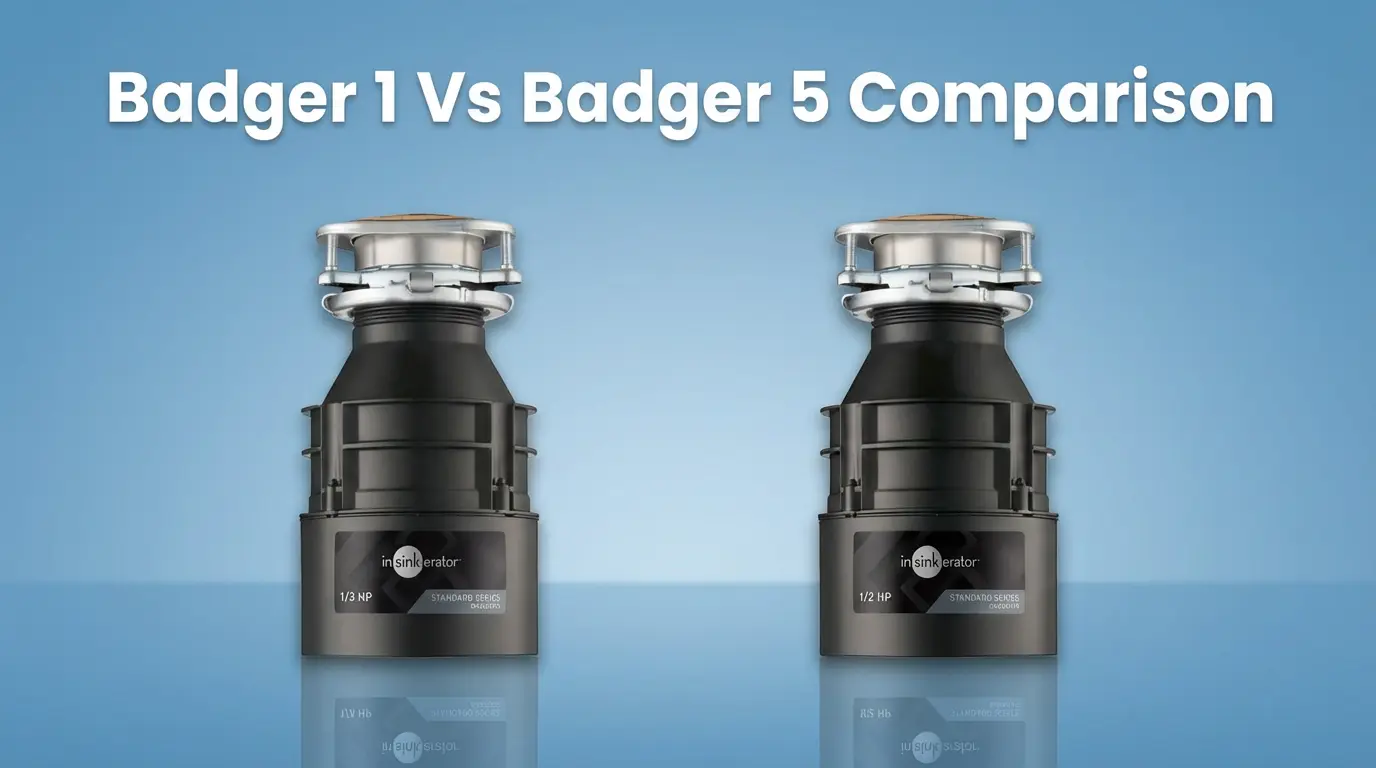
The InSinkErator Badger 1 and Badger 5 look almost identical sitting under a sink. Same housing shape, same galvanized steel chamber, same 3-bolt mounting system, same physical size within an inch. If you opened the cabinet and looked at either one without reading the label, you would not know which was which.
The difference is inside the motor. The Badger 1 runs 1/3 HP. The Badger 5 runs 1/2 HP. That sounds small. In daily kitchen use, it is the difference between a disposal that jams regularly and one that handles normal household scraps without complaint.
Badger 1 vs Badger 5 Comparison
| Feature | Badger 1 | Badger 5 |
|---|---|---|
| Motor | 1/3 HP Dura-Drive Induction | 1/2 HP Dura-Drive Induction |
| Speed | 1,725 RPM | 1,725 RPM |
| Grinding Chamber | 26 oz, galvanized steel | 26 oz, galvanized steel |
| Height | 11.5 inches | 12.6 inches |
| Weight | 12.7 lbs | 13.6 lbs |
| Amp Draw | 5.6 amps | 6.3 amps |
| Mount System | 3-bolt | 3-bolt |
| Noise Insulation | None | None |
| Power Cord | Not included | Not included |
| Warranty | 2 years in-home service | 3 years in-home service |
The Power Difference in Practice
Specs tell you the Badger 5 has 50% more horsepower. What does that actually mean when you are standing at the sink after dinner?
The Badger 1’s 1/3 HP motor handles soft food scraps only. Banana peels, cooked pasta, bread crusts, soft vegetable scraps. Feed it anything with real density or fiber and the motor strains. A chicken bone stops it. Celery strings wrap the impellers. A large batch of potato peels overwhelms the chamber. Every one of those scenarios ends with the disposal humming, the reset button tripping, and you reaching for a hex wrench to free the grinding plate.
The Badger 5’s 1/2 HP adds enough torque that everyday cooking scraps go through without drama. Fish bones, cooked meat trimmings, harder vegetable peels, fruit scraps, and moderate-sized loads process without stalling. It still cannot grind chicken bones or fibrous vegetables like celery and corn husks without risk, but the threshold for what causes a jam is meaningfully higher than the Badger 1.
For a single person who eats light meals and generates almost no food waste, the Badger 1 survives. For anyone who cooks dinner a few times a week for a household, the Badger 5’s extra torque prevents the kind of recurring jams that make people hate their disposal.
What Each Model Can and Cannot Grind
| Food Type | Badger 1 (1/3 HP) | Badger 5 (1/2 HP) |
|---|---|---|
| Fruit peels, soft vegetables | Yes | Yes |
| Cooked pasta, rice (small amounts) | Yes | Yes |
| Bread, crackers | Yes | Yes |
| Cooked meat scraps | Struggles | Yes |
| Fish bones | No | Yes |
| Chicken bones | No | No |
| Fruit pits | No | No |
| Celery, corn husks, artichoke | No | No |
| Large batch loads | Jams frequently | Handles moderately |
Neither model grinds chicken bones, fruit pits, or tough fibrous vegetables reliably. If your kitchen produces those scraps regularly, both Badger models are underpowered. The Badger 5XP at 3/4 HP is the first Badger with enough torque for bones, and the Evolution Compact is the first InSinkErator with multi-stage grinding that handles fibrous foods.
Noise
Neither model has any noise insulation. Both use a basic motor with no SoundSeal packaging, no anti-vibration mounts, no Quiet Collar baffle. They are loud. If your kitchen opens into a living space and disposal noise during dinner cleanup bothers you, neither Badger model solves that problem.
The Badger 5 is marginally louder than the Badger 1 simply because the motor draws more power and runs with more force. In practice, the difference is barely noticeable because both are already noisy enough that conversation pauses when either one runs. If noise is your primary concern, you need to look at the Evolution Series rather than anything in the Badger lineup.
Warranty and Lifespan
The Badger 1 carries a 2-year in-home service warranty. The Badger 5 carries 3 years. Both warranties include InSinkErator sending a technician to your home at no charge if something fails during the coverage period.
In real-world lifespan, both models use galvanized steel grinding components that wear faster than the stainless steel found in premium disposals. Expect 3 to 5 years of effective service from either unit under regular daily use. After that window, grinding performance declines as the galvanized grind ring wears smooth. Our Badger 5 troubleshooting guide covers the common failure symptoms and when replacement makes more sense than repair.
The Badger 5’s extra warranty year matters more than it sounds. A disposal that fails at month 30 is still covered under the Badger 5’s warranty but out of pocket under the Badger 1’s. On a $100 appliance, that coverage difference is worth the $15 to $20 price gap on its own.
Electrical and Installation
Both run on a standard 15-amp kitchen circuit. The Badger 1 draws 5.6 amps. The Badger 5 draws 6.3 amps. Neither requires a 20-amp circuit or dedicated wiring at these power levels, though a dedicated circuit is still recommended practice.
Both use the InSinkErator 3-bolt mounting system. If you are replacing one with the other, the mounting hardware at the sink stays in place. Twist the old unit off, twist the new one on. Neither includes a power cord, so budget $10 to $15 for a compatible cord kit if you are plugging in rather than hardwiring.
Parts are interchangeable between the two models because the chamber, mounting system, and housing dimensions are nearly identical. The splash guard, mounting ring, and discharge tube from a Badger 1 fit a Badger 5 and vice versa.
Our Verdict
Buy the Badger 5. The $15 to $20 difference is trivial. The 50% more horsepower is not. You get meaningfully fewer jams, an extra year of warranty, and a motor that handles normal daily kitchen use without the constant frustration that comes with a 1/3 HP unit pushed past its limits.
The Badger 1 makes sense in exactly one situation: a vacation property or rental unit where the disposal will see light, infrequent use and the lowest possible purchase price is the only factor that matters.
If neither model is powerful enough for your kitchen, the next step up is the Badger 5XP at 3/4 HP ($130 to $160) or a jump to the Evolution Series for stainless steel components and noise insulation. Our buying guide compares every current option across the full price range.
FAQ’s
The Author

Muhammad Nabeel Dar is the founder of GarbageWasteDisposal.com, where he researches and evaluates garbage disposals, kitchen sinks, dishwashers, and kitchen drain systems to help homeowners make confident buying decisions.
After analyzing 30+ garbage disposal models, multiple sink configurations, and a wide range of drain system components across brands like InSinkErator, Waste King, Moen, GE, Frigidaire, and KRAUS, he focuses on what actually matters: real-world performance, build quality, noise levels, installation ease, durability, and overall value.